
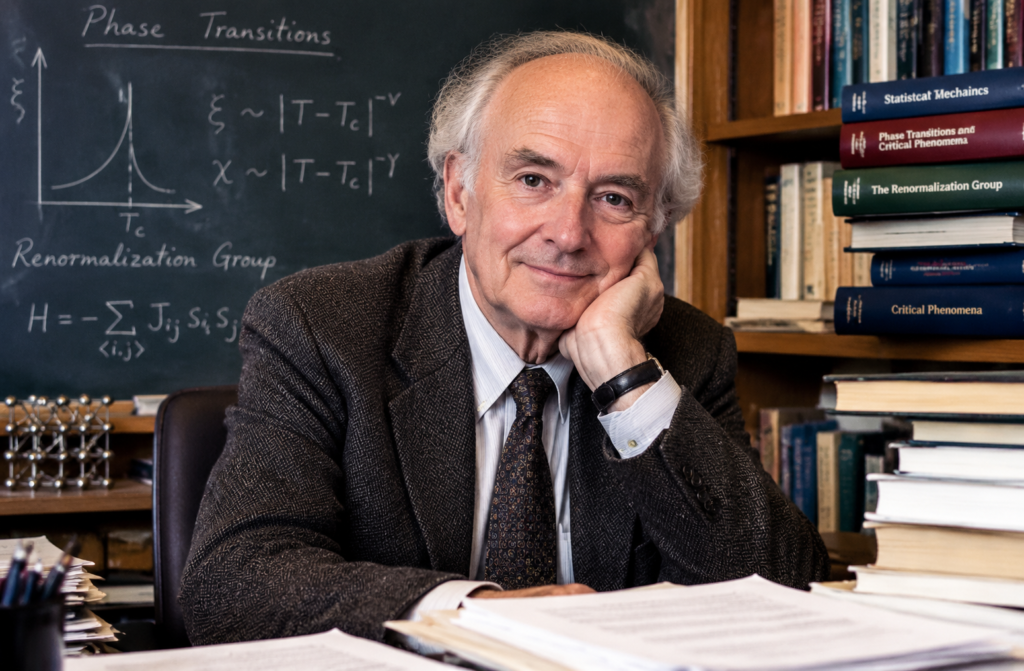
Michael Ellis Fisher was a pioneering physicist known for his groundbreaking work in statistical physics and critical phenomena.
When people think about groundbreaking discoveries in physics, they often imagine dramatic experiments or revolutionary inventions. However, some of the most important advances come from deep mathematical thinking and new ways of understanding how nature behaves. Michael Fisher was one of those rare scientists whose ideas transformed modern physics.
Michael Ellis Fisher was a British-American physicist and mathematician best known for his pioneering contributions to statistical mechanics, phase transitions, and critical phenomena. His research helped scientists understand how materials change from one state to another, such as when water turns into ice or when magnets lose their magnetic properties.
Throughout a career spanning more than six decades, Fisher became one of the most influential theoretical physicists of the 20th century. His work shaped the development of modern physics and influenced fields ranging from mathematics and chemistry to biology and computer science.
This article explores Michael Fisher’s biography, early life, education, scientific career, achievements, personal life, and lasting legacy.
Who Was Michael Fisher?
Michael Ellis Fisher was a renowned physicist, mathematician, and chemist whose research focused on understanding complex systems and the mathematical principles behind physical changes.
| Quick Fact | Details |
|---|---|
| Full Name | Michael Ellis Fisher |
| Born | September 3, 1931 |
| Birthplace | Fyzabad, Trinidad and Tobago |
| Nationality | British-American |
| Profession | Physicist, mathematician, theoretical scientist |
| Known For | Statistical physics, critical phenomena, phase transitions |
| Education | King’s College London |
| PhD | Physics, King’s College London |
| Died | November 26, 2021 |
| Field | Statistical Mechanics |
Although he was not a household celebrity, Michael Fisher became a legendary figure within the scientific community. His theories helped create a new understanding of how large groups of particles behave.
Early Life and Family Background
Michael Ellis Fisher was born on September 3, 1931, in Fyzabad, Trinidad and Tobago, which was then part of the British Empire. His family later moved to England, where he spent much of his childhood and developed an interest in science and mathematics.
From an early age, Fisher showed strong abilities in analytical thinking. He was fascinated by mathematics and the way scientific theories could explain the natural world.
Unlike many scientists who focus on experimental work, Fisher became deeply interested in theoretical approaches. He enjoyed solving complex problems using mathematical models and logical reasoning.
Information about his private family life was limited because Fisher generally kept personal matters away from public attention. His professional contributions remained the main focus of his public identity.
Education and Academic Foundation
Michael Fisher received his education in England and eventually attended King’s College London, one of the United Kingdom’s leading academic institutions.
He studied physics and developed expertise in mathematical approaches to scientific problems. His academic training provided the foundation for his later work in statistical mechanics.
Fisher completed his PhD in physics at King’s College London in 1957. During this period, he became interested in the behavior of systems containing large numbers of interacting particles.
His doctoral research helped establish the direction of a career that would later make him one of the leading theoretical physicists of his generation.
Michael Fisher’s Career Journey
Beginning of His Scientific Career
After completing his doctorate, Fisher began working in academic research. His early career focused on statistical mechanics, a branch of physics that uses mathematics to explain how groups of atoms and molecules behave.
At the time, many scientific questions about phase transitions remained difficult to explain. Fisher became interested in these challenging problems and helped develop new mathematical methods to study them.
Work at King’s College London
Fisher spent important years at King’s College London, where he contributed significantly to theoretical physics research.
During this period, he worked alongside other influential scientists and developed ideas that would later become central to modern statistical physics.
His research focused on understanding critical points — special conditions where materials undergo major transformations.
For example:
- Water changing into steam
- Magnetic materials losing magnetism
- Systems showing sudden changes in behavior
Fisher’s theories helped explain why these transformations occur.
Career at Cornell University
In 1966, Michael Fisher moved to the United States and joined Cornell University.
At Cornell, he became a leading professor and researcher. His work attracted international attention and influenced generations of students and scientists.
He collaborated with other famous physicists, including Kenneth Wilson and Leo Kadanoff, whose research contributed to the development of renormalization group theory.
University of Maryland Years
Later in his career, Fisher joined the University of Maryland, where he continued his research and teaching.
Even after decades of achievement, he remained active in scientific discussions and continued contributing new ideas to physics.
Major Scientific Contributions
Michael Fisher’s impact on science came from several major areas of research.
Phase Transitions and Critical Phenomena
One of Fisher’s most important contributions was his work on critical phenomena.
A phase transition happens when a material changes its state or properties. Examples include:
- Liquid becoming solid
- Liquid becoming gas
- Magnetic materials changing behavior
Near these transition points, traditional physics equations often become difficult to apply. Fisher developed mathematical frameworks that helped scientists understand these unusual behaviors.
His research provided tools that are still used today.
Renormalization Group Theory
Fisher played a major role in the development of renormalization group ideas, a powerful mathematical method used to study systems at different scales.
This approach helped scientists understand how microscopic interactions between particles create large-scale behaviors.
The importance of this work extends beyond physics and has influenced:
- Mathematics
- Computer science
- Biology
- Statistical modeling
Fisher-Kasteleyn-Temperley Algorithm
Michael Fisher was also associated with the development of the Fisher–Kasteleyn–Temperley algorithm.
This mathematical method helped solve problems involving lattice models and combinatorial mathematics.
The work became important in areas connected with statistical physics and computer science.
Achievements and Recognition
During his lifetime, Michael Fisher received many prestigious awards for his contributions to science.
| Award | Year |
|---|---|
| Wolf Prize in Physics | 1980 |
| Boltzmann Medal | 1983 |
| Lars Onsager Prize | 1995 |
| Royal Medal | 2005 |
| BBVA Foundation Frontiers of Knowledge Award | 2009 |
His achievements reflected the importance of his research in understanding complex physical systems.
Many scientists considered him one of the founders of modern statistical physics.
Personal Life
Michael Fisher was known primarily for his scientific achievements rather than public appearances.
He maintained a relatively private personal life and focused much of his energy on research, teaching, and mentoring young scientists.
Fisher was married to Sonia Fisher, and they had children. However, he generally avoided making his family life a subject of public attention.
Outside his scientific work, Fisher was admired for his intellectual curiosity, dedication to education, and commitment to advancing knowledge.
Michael Fisher Net Worth
Unlike entertainers or business figures, Michael Fisher’s wealth was not widely reported publicly.
There are no reliable public records providing an exact figure for Michael Fisher’s net worth.
As an internationally respected professor and researcher, his income would primarily have come from:
| Source | Details |
|---|---|
| Academic salary | University teaching and research positions |
| Research grants | Scientific projects and collaborations |
| Publications | Books and academic works |
| Awards | Scientific prizes and honors |
Any online estimates of his net worth should be treated cautiously because they are not based on verified financial records.
Lifestyle and Legacy
Michael Fisher lived a life centered around science, education, and discovery.
Rather than pursuing fame or luxury, he dedicated his career to solving difficult scientific questions and helping future generations of researchers.
His legacy can be seen through:
- Scientific theories still used today
- Researchers influenced by his work
- Advances in statistical physics
- Applications of his mathematical ideas in other fields
His influence continues through universities, research institutions, and scientific literature.
Lesser-Known Facts About Michael Fisher
- Michael Fisher was born in Trinidad and Tobago before becoming one of Britain’s most influential physicists.
- He worked across multiple disciplines, including physics, chemistry, and mathematics.
- His research helped explain why materials behave differently near critical points.
- Fisher’s work influenced modern approaches to studying complex systems.
- He was a professor at some of the world’s leading universities.
- His research contributed to ideas used beyond traditional physics.
- Fisher received the prestigious Wolf Prize, one of the highest honors in science.
- He collaborated with several leading theoretical physicists of his era.
- Despite his international reputation, he maintained a private personal life.
- His scientific papers continue to be studied by researchers worldwide.
Frequently Asked Questions
What was Michael Fisher famous for?
Michael Fisher was famous for his groundbreaking research in statistical mechanics, critical phenomena, and phase transitions.
When was Michael Fisher born?
Michael Ellis Fisher was born on September 3, 1931.
Where was Michael Fisher born?
He was born in Fyzabad, Trinidad and Tobago.
What did Michael Fisher study?
Michael Fisher studied physics at King’s College London and completed his PhD in physics in 1957.
What awards did Michael Fisher receive?
He received several major scientific honors, including the Wolf Prize, Boltzmann Medal, Lars Onsager Prize, and Royal Medal.
Was Michael Fisher married?
Yes, Michael Fisher was married to Sonia Fisher. He kept much of his personal life private.
What was Michael Fisher’s net worth?
Michael Fisher’s exact net worth was not publicly available. His career income came mainly from academic positions, research, and scientific recognition.
When did Michael Fisher die?
Michael Ellis Fisher died on November 26, 2021.
Final Thoughts
Michael Fisher’s life represents the power of curiosity, mathematics, and scientific dedication. Through his research in statistical physics and critical phenomena, he changed how scientists understand complex systems and phase transitions.
Although he was not a mainstream public figure, his influence within science was extraordinary. His theories continue to shape modern research, making Michael Ellis Fisher one of the most important physicists of his generation.